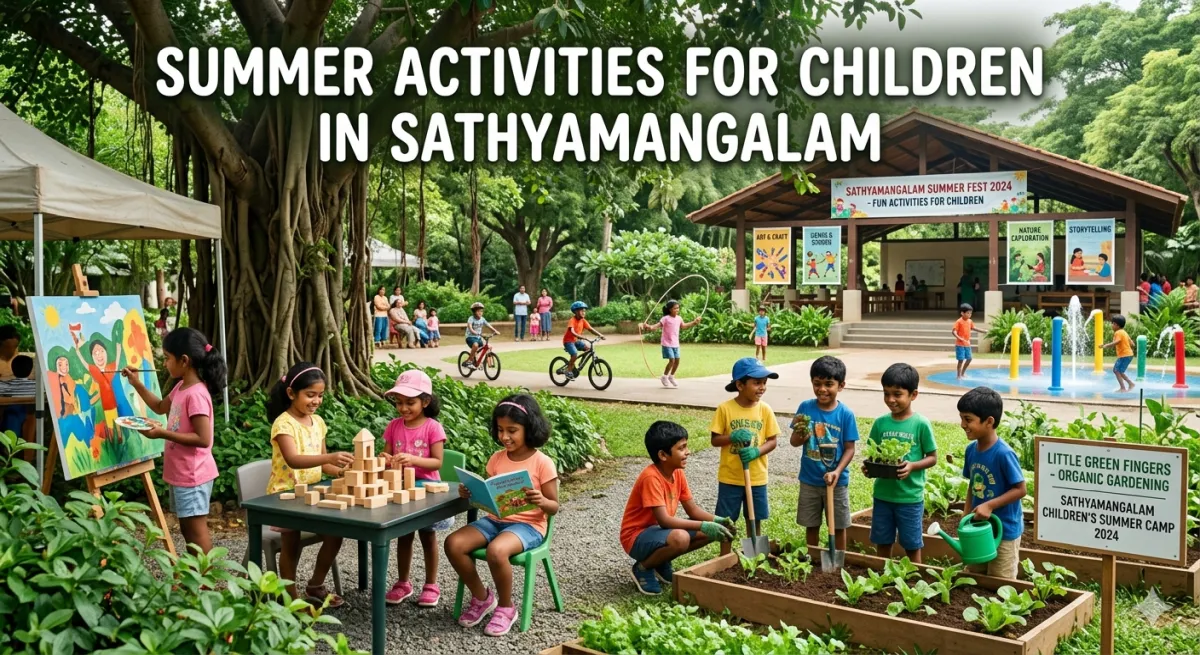
Summer holidays in Sathyamangalam are long, hot, and — if you are a parent — occasionally challenging to fill meaningfully. Between April and June, children have eight to ten weeks without a structured school day, and the default tends to become screens, late nights, and disrupted sleep patterns that take weeks to fix once school resumes.
The good news is that the region and the season both offer options that are genuinely engaging — not manufactured enrichment, but things children in this part of Tamil Nadu can do that are memorable and developmental.
Structured learning activities
Summer camps at local schools and institutions. Several schools in Erode District, including in Sathyamangalam, run short summer programmes covering art, robotics, sports, or languages. These are valuable not just for the activity itself but for the social routine — children interacting with peers outside of their usual classroom group.
Spoken English and communication programmes. Summer is an ideal time to build English confidence in a low-pressure environment. Several coaching centres in Sathyamangalam run 4–6 week spoken English courses aimed at school students. For children moving into Class 6 or above, this is one of the highest-return uses of summer time — better communication skills compound across every subject.
Reading programmes. Set a summer reading goal: one book per week for six weeks. Let the child choose the books. The Erode District Central Library and the Sathyamangalam Town Library both have children's sections. For parents who want structured guidance, several children's reading lists organised by age and interest are available online through Pratham Books and Room to Read India, both of which publish in Tamil and English.
Mathematics and science enrichment. Not tuition — enrichment. Puzzle books, maths games, science experiment kits (available on major e-commerce platforms for under ₹500) keep the logical thinking active without the pressure of marks. A child who spends 30 minutes a day on recreational maths returns to school in June sharper, not rustier.
Outdoor and physical activities
Sathyamangalam sits at the edge of the Nilgiri Biosphere Reserve — one of the most ecologically significant landscapes in South India. This is not background scenery. It is an education resource.
Wildlife awareness visits. The Sathyamangalam Tiger Reserve attracts visitors and researchers from across the country. Older children (Class 5 and above) benefit enormously from guided nature walks or eco-awareness programmes, several of which are organised during school holidays by the Forest Department and local NGOs. Experiencing biodiversity firsthand builds a sense of place and environmental responsibility that no classroom unit can replicate.
Early morning walks and cycling. Before 8 AM, Sathyamangalam is genuinely pleasant. A daily 30-minute walk or cycle — even within the town — builds physical health, reduces screen dependency, and gives children something to do before the day heats up. Children who are physically active during summer return to school better able to concentrate.
Local sports. Cricket, kabaddi, badminton, and throwball are all actively played in Sathyamangalam during summer evenings. Community grounds near Bannari Road and around the central area host informal games. Encouraging children to participate — rather than watch from a phone — builds fitness and peer relationships.
The children who come back to school in June most ready to learn are usually the ones who had the most varied summer — not the ones who studied the most or rested the most.
Creative and household activities
These are often undervalued but developmentally rich:
- Cooking with a parent. Measuring ingredients builds maths intuition. Following a recipe builds reading comprehension. And the result is immediately useful — which is more motivating than most worksheets.
- Drawing, craft, and handmade projects. For younger children especially, unstructured art time builds fine motor skills and creative confidence. It does not need to produce anything impressive.
- Journaling. For children in Class 4 and above, keeping a summer journal — even three sentences a day — maintains writing habits and is genuinely interesting to look back on.
- Learning a musical instrument or classical dance. Many families in Tamil Nadu consider Carnatic music or Bharatanatyam during summer. Discipline, memory, and pattern recognition are all developed through formal arts practice in ways that transfer to academic learning.
The one thing to protect
Sleep schedule. Children whose sleep time drifts by two or three hours during summer — sleeping at midnight, waking at 9 AM — take three to four weeks to return to normal once school starts. Starting to adjust the schedule in the last two weeks of the holiday is far less painful than the first month of a new academic year in chaos.
At The NEST School, Sathyamangalam, we open admissions for the new academic year during this period. If you are considering enrolment for your child for the upcoming year — from Pre KG through Class 12 — visit us at Bannari Road, Sathyamangalam, call +91 99620 09600, or learn more at thenestschools.in.