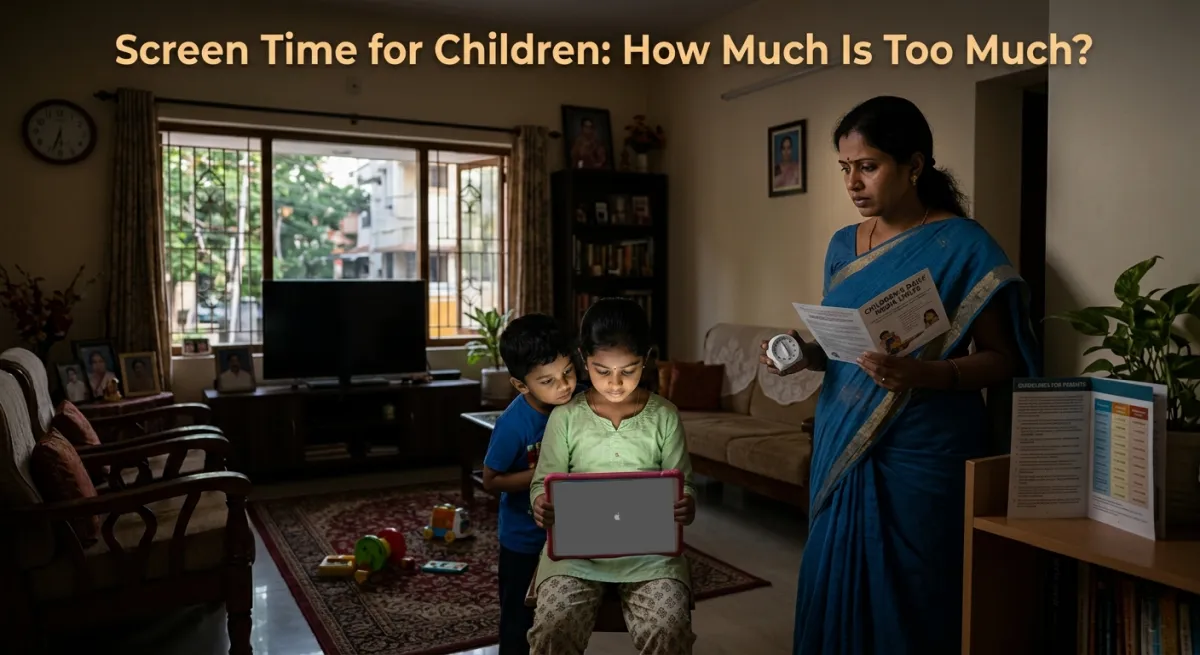
The average Indian child between ages 5 and 12 now spends between 3 and 5 hours a day on screens — and that figure has roughly doubled since 2020. For parents in Tamil Nadu, the question is no longer whether to limit screen time but how, and what the actual harm is when you do not.
The answer is more nuanced than most headlines suggest. Screen time is not uniformly harmful. What matters is the type, the context, and the age of the child.
What the research actually says
The American Academy of Pediatrics and the WHO offer the most widely cited guidelines:
- Under 18 months: no screens except video calls with family
- 18–24 months: only high-quality content, watched with a parent
- 2–5 years: maximum 1 hour per day of quality programming
- 6 years and above: consistent limits on time and type; screens should not displace sleep, physical activity, or face-to-face interaction
These are not arbitrary numbers. They are based on developmental evidence about how young brains build attention, language, and social cognition — and how passive screen consumption can interfere with all three when overdone.
Not all screen time is equal
A child watching a fast-cut YouTube video for 90 minutes is having a very different experience from a child doing a structured coding activity, video-calling a grandparent, or watching a well-paced documentary with a parent who pauses to ask questions.
The harmful pattern is passive, fast-paced, non-interactive content consumed alone — particularly for children under 8. This type of content:
- Trains the brain to expect constant stimulation, making slower activities (reading, listening, classroom learning) feel unbearable
- Displaces the face-to-face interaction that young children need for language development
- Disrupts sleep when used within an hour of bedtime due to blue light and cognitive stimulation
- Reduces physical activity, which is essential for motor development and concentration
The screen itself is not the problem. The problem is what it replaces — and whether it is being used passively or purposefully.
The attention problem schools are seeing
Teachers across Tamil Nadu — including at The NEST School, Sathyamangalam — report a consistent pattern among students who have had unrestricted screen access from a young age: shorter attention spans, lower tolerance for written work, and difficulty sustaining focus during extended explanations. This is not a discipline problem. It is a wiring problem — a brain that has been conditioned to expect novelty every few seconds struggling with the slower pace of genuine learning.
The good news is that this is reversible at young ages. Consistent limits, combined with screen-free periods of reading, outdoor play, and conversation, rebuild attention capacity relatively quickly in primary-age children.
Practical limits that actually work
Rules that work are simple, consistent, and explained rather than just imposed.
- No screens during meals. This is the single most impactful rule for family communication and is easy to enforce.
- No screens for one hour before sleep. This protects sleep quality and is especially important during exam periods.
- A fixed daily window, not a per-request negotiation. "You can watch from 5 PM to 6 PM" is easier to enforce than "not too long" — which is not a limit at all.
- Watch together sometimes. A parent who occasionally watches and comments on what a child is viewing is doing something fundamentally different from a parent who uses the screen as a babysitter. Joint viewing builds the critical media literacy children need as they get older.
What to replace screen time with
Children do not give up screens easily if what replaces them is nothing. The alternatives need to be genuinely engaging:
- Board games and puzzles for ages 6 and above (develops patience, strategy, social skills)
- Outdoor time — even unstructured play in the street or compound is valuable
- Drawing, building, cooking with a parent — hands-on activities that screens cannot replicate
- Reading — with the right book at the right level, this competes well with screens for children who have been well-matched to their books
If you have questions about how we handle technology in the classroom at The NEST School, or how we build attention and focus in early learners, call us at +91 99620 09600 or visit us at Bannari Road, Sathyamangalam. More information is at thenestschools.in.