Coding has become one of those subjects where parents feel perpetually behind — as if there was a correct age to start and their child has already missed it. The reality is more reassuring. There is a right time for different kinds of coding, and starting too early with the wrong approach is more counterproductive than starting later with the right one.
Here is what the evidence and practical experience actually suggest.
Why coding matters — and it is not just about software jobs
The most important thing coding teaches is not syntax. It is computational thinking — the ability to break a large problem into smaller steps, identify patterns, think logically about cause and effect, and debug when something does not work as expected.
These are general cognitive skills. A child who has learned to think through a coding problem is better at maths word problems, science investigations, and essay planning. The skill transfers. This is why coding is valuable even for children who will never become software engineers.
Ages and approaches
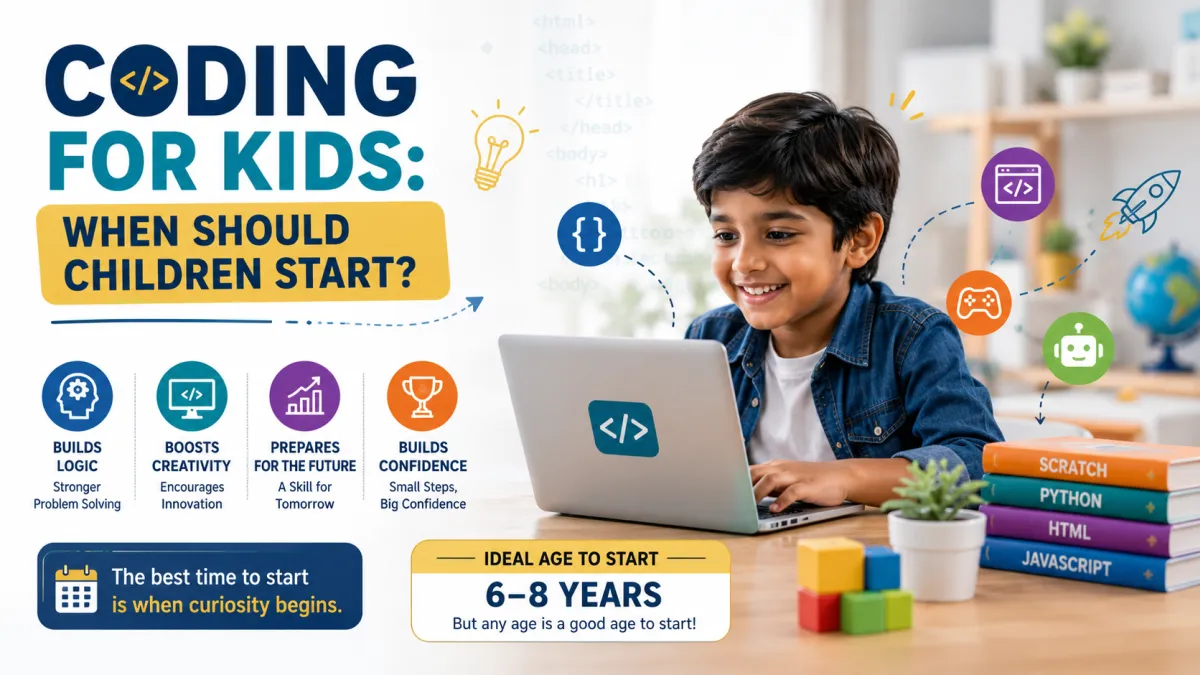
Ages 4–6: Pre-coding (unplugged activities)
Children this age are not ready for screen-based coding tools. What they can do is engage with the underlying logic. "Give the teddy bear instructions to reach the door" — giving step-by-step directions, debugging when the teddy gets stuck, thinking in sequences. These unplugged activities build the mental model that coding tools will later plug into.
Ages 6–8: Visual block coding
This is the ideal entry point for screen-based coding. Tools like Scratch Jr (tablet) use drag-and-drop blocks to build animations and simple stories. There is no syntax to learn — the logic is entirely visual. Children see immediate results, which maintains motivation. A child this age can build a character that moves, speaks, and reacts to clicks within a few sessions.
Ages 8–10: Scratch and game-based coding
Scratch (the full version, used in browsers) is the global standard at this age. It introduces variables, loops, conditionals, and event-based programming through game and animation building. MIT developed it specifically for this age group, and over 100 million projects are shared on the Scratch platform. This stage develops real programming logic without the frustration of typed syntax.
Ages 10–12: Introduction to text-based coding
Python is the recommended starting language for this age. It has minimal syntax clutter, reads almost like English, and is genuinely used by professionals — so the transition to "real" coding is not a new language to learn later. At this stage, children can build simple calculators, quizzes, and basic games using typed code.
Starting at 10 with a good teacher and the right language produces better outcomes than starting at 7 with the wrong approach and pressure to perform.
Ages 12 and above: Specialisation
By Class 7 or 8, children with a foundation can begin exploring web development (HTML, CSS, JavaScript), app development, robotics, or data science depending on interest. At this point, self-directed learning with structured projects becomes possible.
Signs a child is ready to start
- Can follow multi-step instructions reliably (usually 5–6 years)
- Enjoys puzzles and problem-solving activities
- Can handle some frustration without giving up immediately (critical for debugging)
- Has basic reading ability for text-based tools (ages 8+)
What to avoid
Pressure. Coding introduced as a competitive activity — "your classmate already knows Python" — produces anxiety, not programmers. It should feel like creative play, especially in the early years.
Starting with typed code too early. A 6-year-old debugging a Python syntax error is not learning coding. They are learning frustration. Use visual tools until the child is ready for text.
Treating it as a separate subject. The best coding learning happens in connection with something the child cares about — making a game, building something, solving a problem they found themselves. Coding as an isolated subject is less effective than coding as a tool for making something real.
At The NEST School
At The NEST School, Sathyamangalam, our Atal Tinkering Lab (part of the AIM–NITI Aayog national initiative) gives students from Class 6 onwards access to robotics, electronics, and hands-on technology projects. Combined with our IIT School Connect programme, students are exposed to real engineering thinking — not just coding as a separate skill, but technology as a tool for solving meaningful problems.
If you are a parent curious about how technology is integrated into learning at our school, visit us at Bannari Road, Sathyamangalam, call +91 99620 09600, or explore our curriculum at thenestschools.in.