You have probably seen "XSEED Education" listed on a school's website or admission brochure. But what does it actually mean for your child, in the classroom, on a Tuesday morning?
This is the plain-language version — no jargon, no sales pitch.
What XSEED is
XSEED Education is a curriculum and teacher training company founded in Singapore and now used in over 3,000 schools across India. It does not replace the Tamil Nadu Matriculation Board syllabus — it changes how that syllabus is taught.
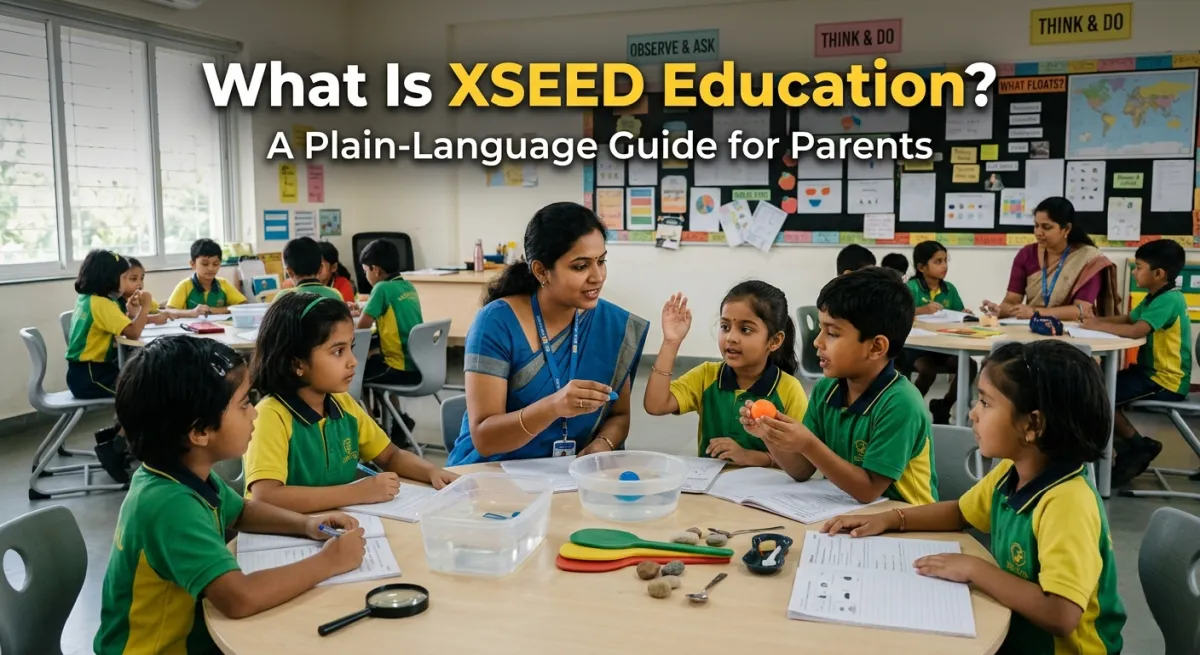
That distinction matters enormously. Your child still learns the same topics. But instead of a teacher explaining a concept and students copying it into their notebooks, the lesson is designed so that students discover the concept themselves — through activity, discussion, and structured practice.
The 5-step XSEED learning cycle
Every XSEED lesson follows the same five steps, regardless of subject or grade:
Step 1 — Experience
The lesson begins with an activity, a question, or a real-world scenario. No concept is introduced until curiosity is activated. A Class 7 science lesson on electricity might begin with students connecting a simple circuit and observing what happens when they add a second bulb.
Step 2 — Share
Students discuss what they observed. They tell the class what surprised them, what they think is happening, what they already know. This is not just about talking — it builds communication skills and surfaces the prior knowledge the teacher can then build on.
Step 3 — Process
Now the teacher draws out the concept — but from the students' own words and observations. The teacher guides; the class discovers. Understanding that is discovered sticks. Understanding that is received evaporates before the exam.
Step 4 — Apply
Students work individually and in groups through structured practice problems. This is deliberate consolidation — not homework for the sake of quantity, but targeted work that deepens the concept just learned.
Step 5 — Know More
Extension questions and real-world connections push curious students further. No child is bored. No child is left behind. The lesson expands to meet every pace in the class.
A child who understood why a formula works will always outperform one who only remembered it.
Why it matters for board results
Tamil Nadu Matriculation Board exams — and increasingly, all national exams — include application-based questions that rote learners struggle with. A student who memorised Newton's Second Law may not be able to explain why a heavier bag is harder to carry. A student who discovered the concept through an XSEED activity can.
At The NEST School, Sathyamangalam, XSEED has been embedded into daily classroom practice since the school's renewal under new management. Our 2026 board results reflect the outcome: 100% pass rate in both Class 10 and Class 12, with 13 Class 10 distinctions (scores 450–483 out of 500).
What to ask an XSEED school
XSEED is a strong signal — but only if the school implements it faithfully. Before enrolling, ask:
- Are all teachers XSEED-trained, or only some?
- How long have you been using the framework?
- Can I observe a lesson?
At The NEST School, all 20 faculty members are XSEED-certified. The framework is not an add-on — it is how we teach, every day, in every class.
Walk-in visits welcome at Bannari Road, Sathyamangalam, Monday to Saturday, 8:30 AM to 4:30 PM. Call us at +91 99620 09600 to ask any question first.