There is a well-known learning pyramid, often attributed to the National Training Laboratories, that summarises how much information people retain depending on how they encounter it. Lectures: around 5%. Reading: 10%. Demonstration: 30%. Practice by doing: 75%. Teaching others: up to 90%.
Whether you accept those exact numbers or not, the directional truth is hard to argue with — children learn more when they do things than when they are told things. This is the core idea behind experiential learning, and it is the reason progressive schools have been restructuring classrooms around it for the past two decades.
What experiential learning actually means
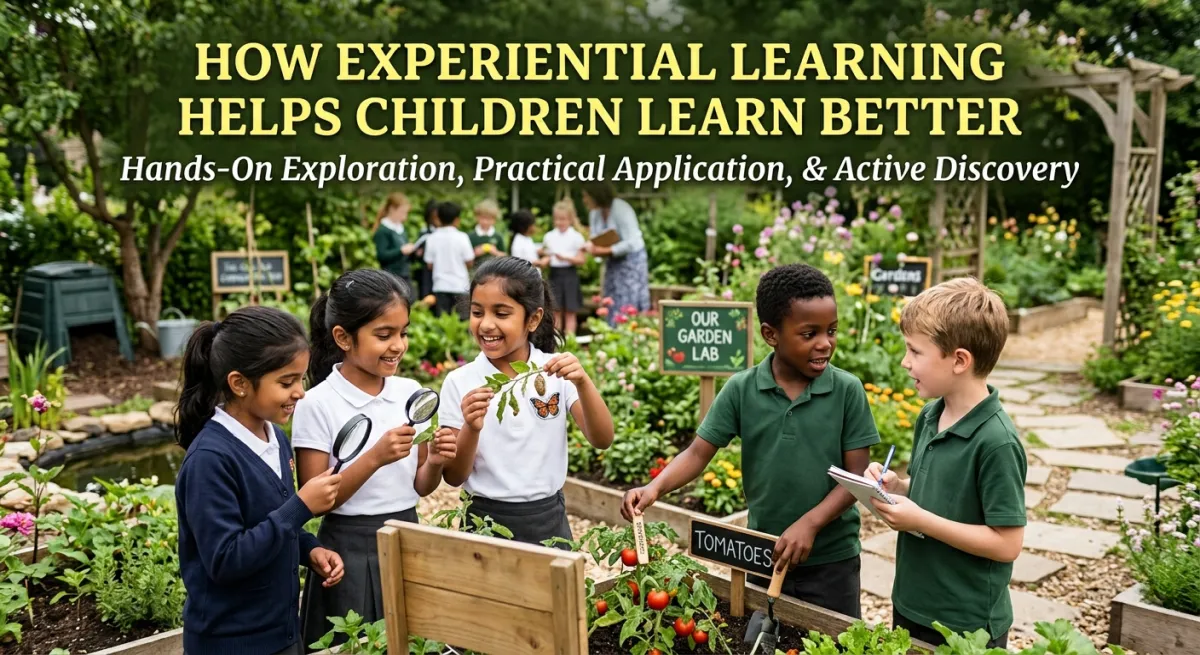
Experiential learning is not the same as unstructured play, project days, or keeping children busy with activity. It is a deliberate teaching method in which the learning cycle follows four stages:
- Concrete experience — the child does something, handles something, or observes something real
- Reflective observation — the child thinks about what happened and what they noticed
- Abstract conceptualisation — the teacher connects the observation to the underlying concept or principle
- Active experimentation — the child applies the concept to a new situation
This cycle, developed by education theorist David Kolb in 1984, is the backbone of most modern active learning frameworks — including XSEED Education, which is used at The NEST School, Sathyamangalam.
Why traditional instruction falls short
Traditional instruction is efficient. A teacher can cover a chapter in forty minutes. But efficiency is not the same as learning. When a child copies definitions from the board, they are encoding symbols, not understanding. Ask the same child two weeks later what osmosis means, and the word may still be there — the concept rarely is.
The problem is that the brain does not store information like a file cabinet. It builds meaning through association, pattern recognition, emotion, and repetition of use. Abstract explanations without concrete anchors are processed shallowly and forgotten quickly.
A child who has squeezed a soaked raisin and watched it shrink understands osmosis in a way a definition cannot replicate.
What it looks like in the classroom
Experiential learning does not require expensive equipment or elaborate setups. In a well-designed classroom, it shows up as:
- Science: experiments that come before explanations, not after. Children observe first, then the teacher introduces the vocabulary for what they saw.
- Mathematics: physical materials — blocks, counters, number lines — used before abstract symbols. The symbol 7 means something because the child has handled seven objects.
- Language: storytelling, role play, and discussion before written comprehension. Children who talk about a text understand it more deeply than those who read and answer questions silently.
- Social studies: maps drawn from memory, local surveys, interviews — connecting the subject to something physically familiar.
The role of the teacher
Experiential learning places higher demands on teachers, not lower ones. The teacher's job shifts from deliverer of content to designer of experiences and guide through reflection. This requires subject depth, classroom observation skills, and the confidence to let children be confused temporarily — because productive confusion is where learning actually starts.
At The NEST School, our 20 trained faculty members work within the XSEED framework, which structures every lesson around this cycle. Teachers are not reading from a script. They are designing the entry point — the concrete experience — and then guiding the class through to concept and application.
The long-term difference
Children taught through experiential methods consistently show stronger performance in problem-solving, critical thinking, and application-based questions — the kind that now appear in Class 10 and Class 12 board exams. More importantly, they remember what they learn. Not just until the exam, but after it.
If you are choosing a school for your child in Sathyamangalam or Erode District, ask the school how a typical lesson is structured. Ask whether children experiment before they are taught, or only after. The answer will tell you a great deal about the kind of learning your child will actually experience.
At The NEST School, Bannari Road, Sathyamangalam, admissions are open for the upcoming academic year. Call us at +91 99620 09600 or visit thenestschools.in to learn more about our curriculum and teaching approach.