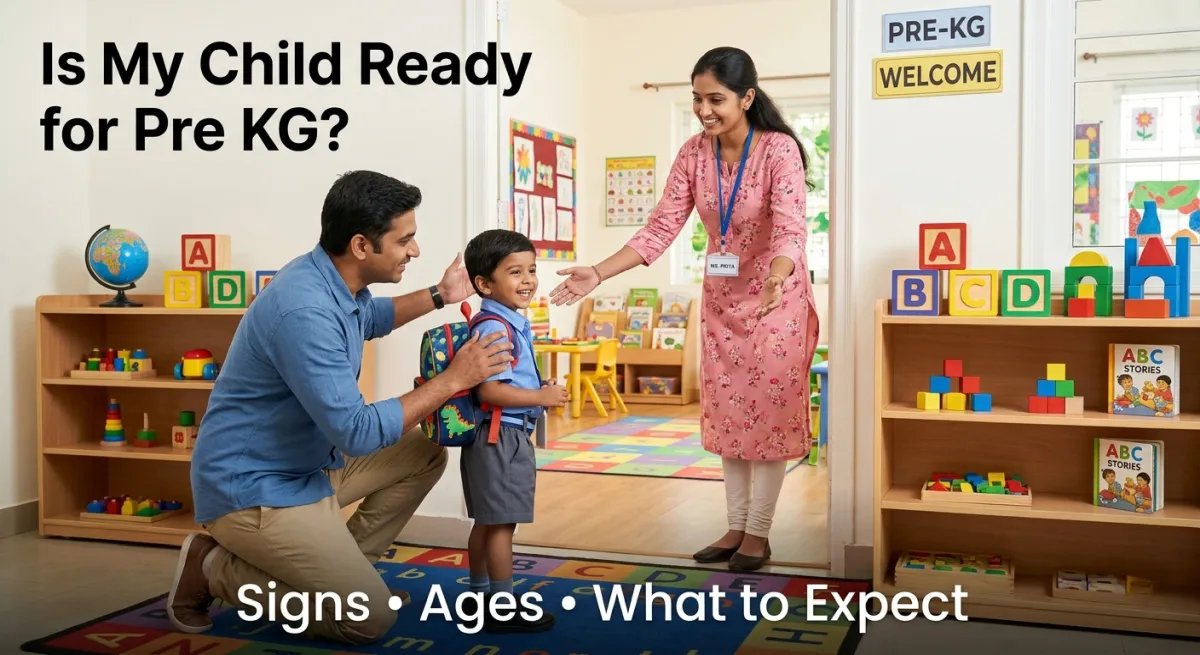
Your child just turned two and a half, and suddenly everyone — the neighbour, the relative at the last family gathering, the school admission brochure — is suggesting it is time for Pre KG. But is it?
The answer depends far less on age than on a small set of developmental readiness signs. Here is what to look for.
What Pre KG actually involves
Pre KG (Pre-Kindergarten) in Tamil Nadu typically takes children from age 3 and focuses on structured play, early language development, social interaction, and basic motor skills. It is not academics. It is the foundation on which academic learning later sits.
At The NEST School, Sathyamangalam, Pre KG is taught through the XSEED active learning framework — which, for young children, means learning through experience, exploration, and guided play rather than worksheets and rote repetition. This matters, because the wrong approach at this stage can make a child dislike school before they have ever had a reason to.
Signs your child may be ready for Pre KG
These are not checklist requirements — they are signs that your child will settle in comfortably:
- Can spend time away from you without major distress. Brief separation anxiety is normal. Extended, inconsolable distress every day is a signal to wait a little longer.
- Shows curiosity about other children. Interest in watching, approaching, or playing alongside other kids (even without fully playing with them) is a good sign.
- Can follow a simple two-step instruction. "Please pick up the toy and put it on the shelf" — that level of comprehension suggests classroom readiness.
- Can communicate basic needs. Whether in words, signs, or clear gestures — can your child tell you when they are hungry, thirsty, or need the bathroom?
- Has a basic routine. Children who are used to sleeping, eating, and waking at predictable times settle into the school day more easily.
Signs your child may benefit from a little more time
A child who starts six months later and is ready will always learn more quickly than one who starts on schedule but is not.
- Extended separation distress that does not reduce over several weeks
- Very limited verbal communication for their age
- Difficulty with any structured activity, even briefly
- Significant sleep disruption or very irregular eating patterns
None of these mean something is wrong. They mean your child needs a few more months of home-based development before they are ready to thrive in a classroom setting.
The age question
Most schools in Tamil Nadu admit children to Pre KG from age 3. Some accept children as young as 2.5 years. The cut-off matters less than readiness. A calm, curious, communicative 2.8-year-old will usually settle better than an anxious 3.2-year-old. Trust what you observe in your own child over what a cut-off date tells you.
What to look for in the school itself
For Pre KG specifically, the school environment matters as much as your child's readiness. Visit before enrolling and notice:
- Is the early childhood space colourful, open, and play-oriented?
- Do the teachers look calm and patient — or rushed?
- What is the child-to-teacher ratio in the Pre KG class?
- How does the school handle a child who is upset on arrival?
At The NEST School, our Pre KG and primary classrooms are designed around the XSEED framework for early learners — active, play-integrated, and led by teachers who are trained to build confidence before content. Our campus on Bannari Road, Sathyamangalam is open for visits Monday to Saturday, 8:30 AM to 4:30 PM. We encourage all parents to visit before deciding — and to bring their child along so you can observe how they respond to the space.