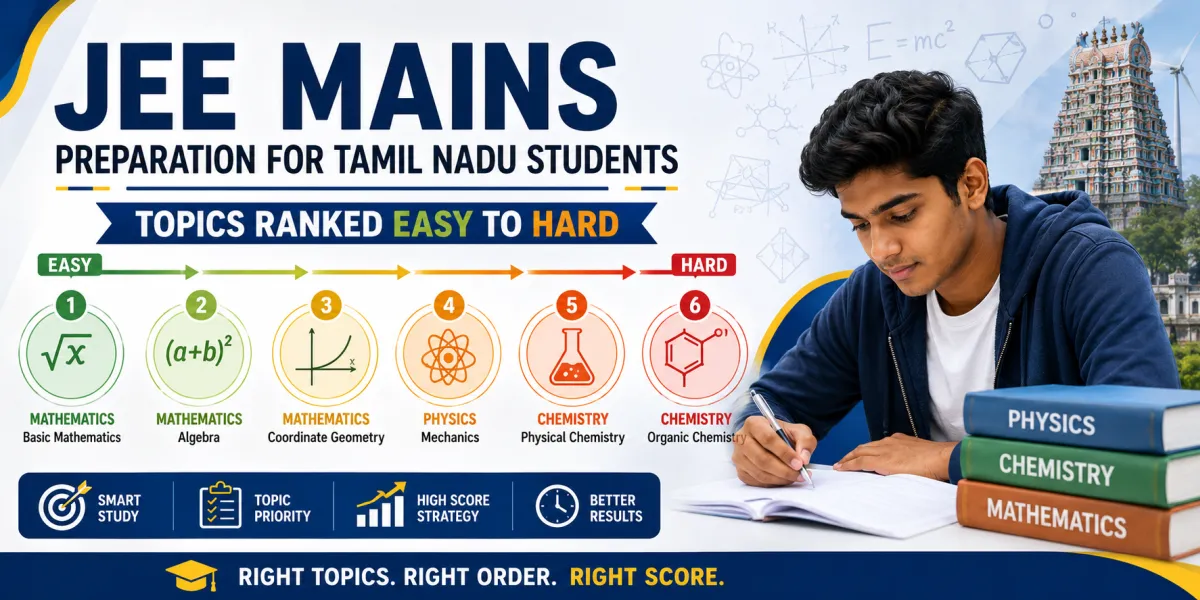
JEE Mains tests Physics, Chemistry and Mathematics — 75 questions, 300 marks. Unlike NEET, there is no fixed syllabus document that tells you exactly what to expect. And unlike Samacheer Kalvi, JEE tests problem-solving and mathematical reasoning, not just content recall.
This is the guide Tamil Nadu students on Samacheer Kalvi specifically need — because the gap between Samacheer and JEE is larger than most parents and students realise.
The critical warning for Tamil Nadu students
Samacheer Kalvi does not fully cover the JEE syllabus. This is not a criticism of the board — it is a structural fact. Samacheer is designed for the Tamil Nadu board exam. JEE is a national engineering entrance designed on NCERT content. The overlap is partial.
What this means practically: Tamil Nadu students who study only from Samacheer textbooks will find several JEE Mains chapters completely unfamiliar. The most important supplement is NCERT textbooks (Classes 11 and 12) for all three subjects.
Mathematics — 25 questions, high difficulty
Easy topics (Samacheer covers these well):
- Trigonometry — identities, equations, inverse functions — consistent marks
- Quadratic equations and complex numbers (basics) — foundational
- Statistics and probability — moderate effort, predictable question types
- Straight lines and circles — Class 11 coordinate geometry, well-covered
Medium topics (need dedicated practice beyond school):
- Differential calculus (limits, continuity, derivatives) — requires NCERT + extra problems
- Integral calculus — high marks weight, needs consistent daily practice
- Coordinate geometry (parabola, ellipse, hyperbola) — formulae-heavy, applications need work
- Matrices and determinants — structured, good return on practice
Hard topics (require coaching or exceptional self-discipline):
- Complex numbers (advanced) — argument, modulus, De Moivre's theorem
- Permutations and combinations — abstract reasoning, requires a different kind of thinking
- 3D geometry and vectors — spatial reasoning, not intuitive without extensive practice
- Mathematical reasoning and sets — conceptual, not always taught deeply in school
Recommended reference: RD Sharma for Maths basics, then Arihant or previous year papers for JEE-level problems.
Physics — 25 questions
Easy topics:
- Units and dimensions — always in JEE, straightforward
- Kinematics — Class 11, good Samacheer coverage
- Laws of motion and friction — predictable numericals
- Work, energy, power — concept + formula, manageable
Medium topics:
- Rotational motion — moment of inertia, torque — requires more depth than Samacheer
- Thermodynamics and kinetic theory — conceptual + numerical mix
- Electrostatics and capacitors — high marks weight, needs NCERT depth
- Current electricity — Kirchhoff's laws, RC circuits, practical problem types
Hard topics:
- Wave optics — interference, diffraction, polarisation — not in Samacheer adequately
- Electromagnetic induction and AC circuits — requires strong conceptual grip
- Modern physics — photoelectric effect, de Broglie, Bohr model — conceptual depth essential
- Semiconductors — logic gates, diodes, transistors — often underestimated
Recommended reference: HC Verma (Concepts of Physics) — essential for JEE Physics. Work through solved examples, not just theory.
Chemistry — 25 questions
Easy topics:
- s-block and p-block elements — factual, predictable
- Basic organic chemistry — IUPAC nomenclature, isomerism
- States of matter — gas laws, conceptual
Medium topics:
- Chemical bonding and molecular structure — requires NCERT depth
- Organic reactions (alcohols, aldehydes, carboxylic acids) — mechanisms need consistent practice
- Chemical equilibrium and ionic equilibrium — pH, buffer, solubility — numericals
- Thermodynamics — ΔH, ΔG, ΔS — conceptual + numerical
Hard topics:
- Electrochemistry — cell reactions, Nernst equation, electrolysis numericals
- Coordination compounds — naming, isomerism, VBT and CFT — consistent JEE favourite
- Polymers and biomolecules — Class 12, often underestimated
JEE Mains vs JEE Advanced
Only approximately 2.5 lakh students qualify for JEE Advanced out of around 11 lakh who appear for JEE Mains. JEE Advanced is a completely different exam — it tests higher-order thinking and has no defined syllabus. For JEE Advanced, almost all successful candidates had structured coaching or mentoring. Self-study alone is extremely rare at the top ranks.
For JEE Mains, disciplined self-study with NCERT + good reference books is achievable with the right foundation.
The foundation that makes the difference
The students who crack JEE from small towns are not smarter. They started with stronger fundamentals and used their time more deliberately.
At The NEST School, Sathyamangalam, Class 9 and 10 students build exactly that foundation through the XSEED active learning framework — developing the problem-solving mindset that JEE demands. If you are considering which school gives your child the best preparation for competitive exams, visit us at Bannari Road, Sathyamangalam or call +91 99620 09600.